


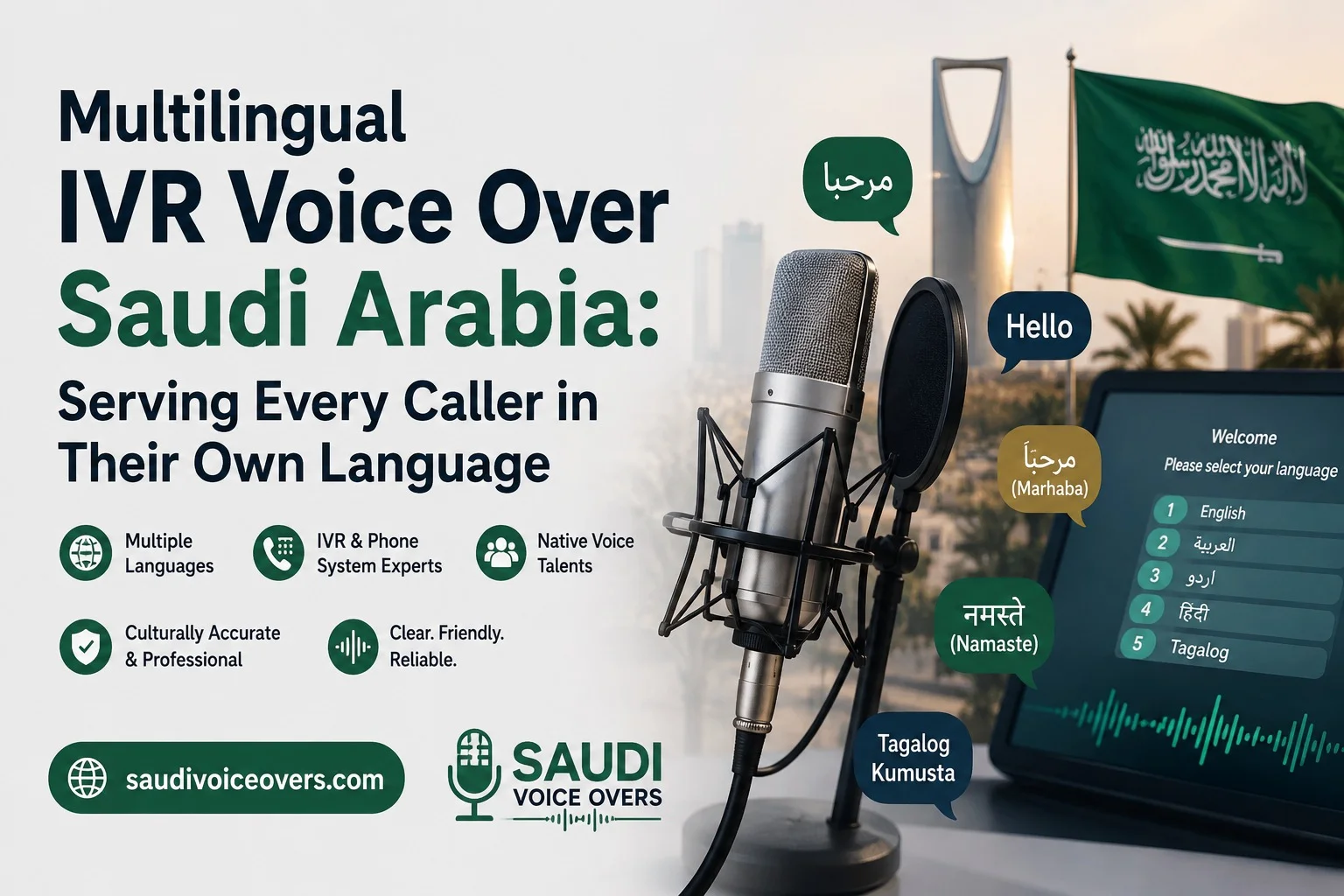



Multilingual IVR Voice Over Saudi Arabia is what turns a confusing phone menu into a smooth first impression. Call a bank, telecom provider, or government service line in Riyadh or Jeddah, and the first voice a customer hears has one job: make a caller from Dammam, Manila, Mumbai, or London feel like the system was built for them. Getting this right shapes first-call resolution, customer satisfaction, and how professional your brand sounds before a human agent ever picks up.
Why Saudi IVR Systems Can’t Be Single-Language
Saudi Arabia’s workforce and customer base span Saudi nationals, GCC residents, and a large population of expatriate workers from South Asia, Southeast Asia, and beyond. A call center that only routes callers in Arabic — or only in English — is quietly frustrating or losing a significant share of its callers. A well-built multilingual IVR system typically needs to:
- Greet the caller in a neutral opening (often bilingual Arabic-English)
- Offer a clear language selection menu
- Route each subsequent prompt in the caller’s chosen language, in a consistent tone and pace
- Maintain the same brand “voice personality” across every language track
That last point is where many IVR projects fall apart. Businesses record English prompts with one studio, then add Arabic or Hindi prompts later, through a different vendor. The mismatch in tone, pacing, and audio quality is obvious to callers, even if they can’t quite explain why the experience feels disjointed.
The Languages Saudi IVR Systems Actually Need
Based on real call patterns across Saudi businesses, the most requested IVR languages are:
- Arabic (Modern Standard or Najdi/Khaleeji-accented) — for Saudi nationals who expect a warm, locally accented greeting rather than a generic Levantine or Egyptian Arabic voice
- English (neutral or British-leaning) — the default for corporate, government, and expat-facing lines
- Hindi and Urdu — essential for retail, construction, and logistics businesses serving South Asian communities
- Tagalog and Bengali — increasingly requested by healthcare providers, facilities management, and hospitality brands with large workforces from these communities
A strong IVR partner doesn’t just supply a voice per language — they match dialect to audience. A Najdi-accented Arabic prompt lands very differently with a Saudi national than a generic MSA recording pulled from a stock voice library.Businesses operating across the wider Gulf often need this same dialect-matching discipline extended to the UAE market, which is why many turn to a dedicated Dubai voice over studio when their call center or campaign spans both Saudi and Emirati audiences.
What Makes an IVR Recording “Studio-Grade”
IVR audio carries stricter technical requirements than most voice-over work, because it has to perform flawlessly through telecom systems, not just headphones or speakers:
- Zero background noise or room tone — telecom compression exaggerates any hiss or hum
- Consistent levels across every single prompt file — so no menu option sounds noticeably louder or quieter than the last
- Correctly formatted file naming and folder structure — IVR systems often require dozens or hundreds of individual prompt files, and one mislabeled file can break a call flow
- Exact timing and pacing — prompts need to be long enough to be understood but short enough that callers don’t get impatient waiting for their option
This is also why updating a single word or promotional message later shouldn’t mean re-recording the whole tree. Working with a studio that keeps your original voice artist, mic setup, and project files on file makes future updates fast and consistent.
A Realistic IVR Voice Over Project Timeline
For a Saudi business setting up multilingual IVR for the first time, a typical process looks like:
- Script and menu mapping — your call flow (main menu, sub-menus, hold messages, error prompts) is scripted in each target language
- Voice casting — you review sample voices per language and select the tone (formal, friendly, authoritative) that fits your brand
- Recording — each language is recorded in a single, consistent studio session
- QA and file delivery — prompts are checked against the call flow, named per your phone system’s requirements, and delivered in the right audio format (usually WAV or specific telecom codecs)
Most Saudi-focused studios can turn around a full multilingual IVR project in 24–72 hours once scripts are finalized — useful if you’re launching a new hotline or refreshing an existing one under deadline.
Common Mistakes to Avoid
- Using machine-translated scripts. A script translated literally from English into Arabic or Hindi often reads awkwardly out loud, even if it’s grammatically correct on paper. Have a native speaker review the script for how it sounds, not just how it reads.
- Skipping a dialect check. “Arabic” isn’t one voice — an Egyptian-accented Arabic prompt on a Saudi government or banking line can feel noticeably out of place to local callers.
- Recording languages at different times with different artists. This creates inconsistent brand tone across your phone system.
- Forgetting hold messages and error prompts. These are recorded far less often than main menus but are heard just as frequently, sometimes more, during high call volume.
Frequently Asked Questions
How many languages should a Saudi business include in its IVR system?
Most enterprises see the best return from three to four languages — typically Arabic, English, and one or two languages matching their specific customer base (Hindi, Urdu, or Tagalog for retail, construction, and logistics, for example).
Can I update just one IVR prompt without re-recording the whole system?
Yes, as long as the studio keeps your original voice artist and project files on record. A single menu change or promotional update is normally a quick add-on session, not a full project.
What audio format do IVR systems need?
Most PBX and cloud phone systems accept WAV files, though some hardware requires specific codecs or bitrates. A good studio will ask which phone system you use and deliver files pre-formatted to match.
How long does a multilingual IVR recording project take?
Once scripts are finalized and approved, recording and delivery across multiple languages typically takes 24–72 hours. Script writing and dialect review can add a few extra days upfront.
Does IVR voice-over need a different voice than my ads or website videos?
Not necessarily the same voice, but it should share the same tonal personality — warm, authoritative, energetic, whatever fits your brand — so your phone system, website, and marketing feel like one consistent brand experience.
Getting Started
If you’re setting up or refreshing an IVR system for a Saudi business, start by mapping out your full call flow and identifying which languages actually reflect your caller base — not just the languages you assume matter most. From there, a studio that specializes in Gulf-region multilingual recording can match dialect, tone, and technical formatting so every caller, in every language, hears a consistent, professional brand voice.
Ready to record your multilingual IVR prompts? Get in touch for a free consultation and sample voices in the languages your callers actually speak.