


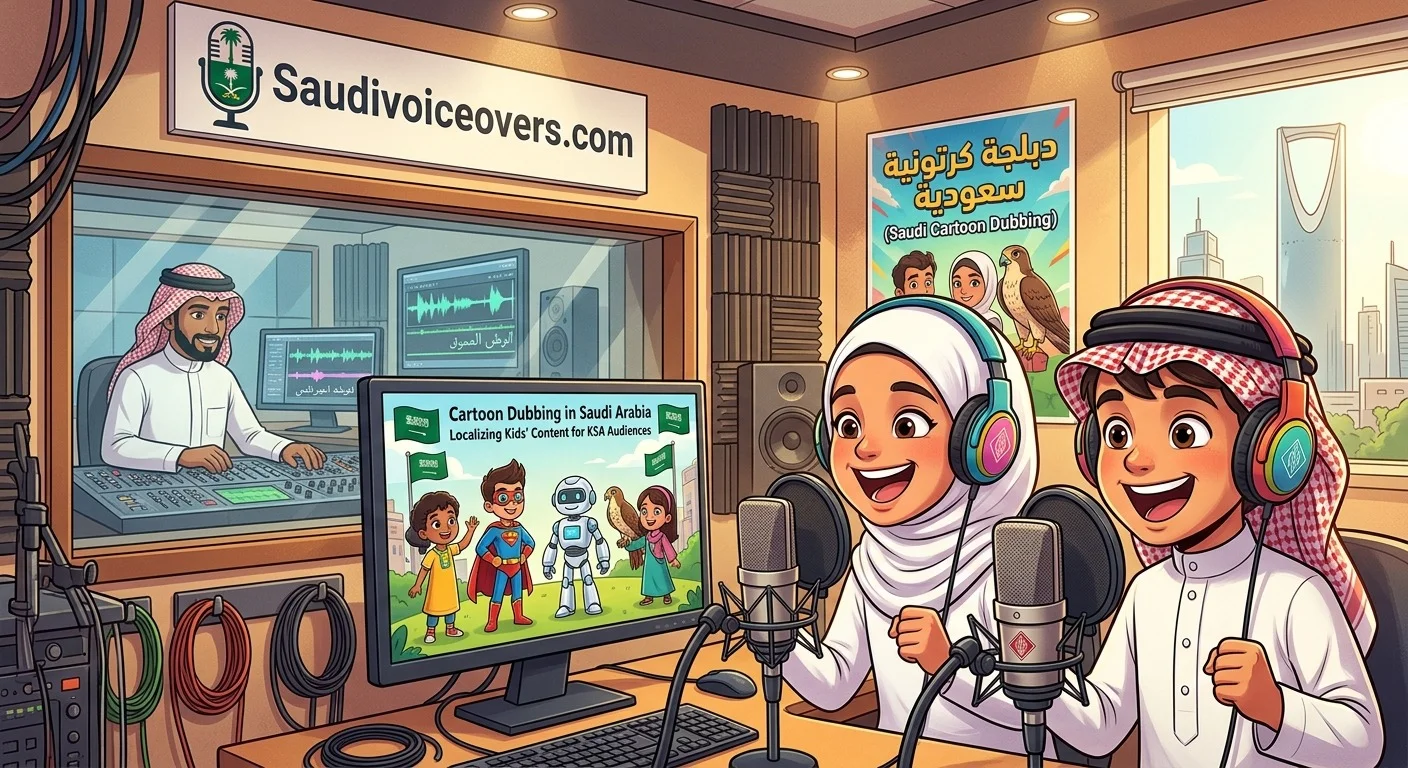



Cartoon Dubbing in Saudi Arabia is what makes every animated character — whether from a global streaming platform, a regional broadcaster, or a homegrown production — sound right in the language and dialect a child actually speaks at home. Cartoon dubbing voice over in Saudi Arabia sits at the intersection of performance, translation, and technical precision, and it’s very different from adult dubbing or standard voice-over work.
Why Cartoon Dubbing Is Its Own Discipline
Dubbing an animated character isn’t just translating dialogue and recording it — it’s recreating a performance. A few things make it distinct from other voice work:
- Character consistency — the same voice actor typically needs to voice a character across dozens or hundreds of episodes, maintaining the exact same pitch, energy, and personality every time
- Lip-sync and timing — dialogue has to fit the mouth movements and pacing already animated into the character, which often means the translated line has to be rewritten, not just translated, to fit the same rhythm
- Age-appropriate tone — children’s content demands a level of warmth, clarity, and expressiveness that reads as “fun” rather than “performed,” which requires genuinely skilled voice actors, not just anyone with a pleasant voice
Because of this, cartoon dubbing casting usually prioritizes acting range and vocal flexibility over raw vocal beauty — a great cartoon voice actor can shift between excited, sad, mischievous, and calm within a single scene, convincingly.
Languages in Demand for Saudi Cartoon Dubbing
Saudi Arabia’s large youth population and fast-growing streaming and broadcast market mean cartoon dubbing projects here typically need:
- Arabic (usually Modern Standard Arabic for broad Gulf and pan-Arab distribution) — the most common target for children’s content aimed at Saudi and wider MENA audiences
- Khaleeji-accented Arabic — for locally produced content aimed specifically at Gulf children, where a regional accent feels more familiar than broadcast-standard MSA
- English — including redubbing for accent adjustment, common for international co-productions distributed regionally
A single animated series is frequently dubbed into two or three of these variants for a single Saudi-based distributor, which makes working with one studio across all versions valuable — it keeps character voice matching, quality standards, and delivery timelines consistent.For productions also targeting the UAE market, teams often coordinate with a dedicated Dubai voiceover partner to keep casting and delivery standards aligned across both markets.
The Cartoon Dubbing Process, Step by Step
- Script adaptation — the original dialogue is translated and then adapted so lines match the timing and lip movements of the animation, which usually means a professional adapter reworks the literal translation into something that fits naturally
- Voice casting — actors are matched to characters based on vocal range, age, and personality fit, often through auditions against reference clips of the original performance
- Directed recording sessions — unlike straight narration, cartoon dubbing sessions are typically directed in real time, with a director guiding pacing, emotion, and energy scene by scene
- Sync and quality review — recorded dialogue is checked against the video to confirm it holds up against mouth movements and scene timing
- Final mix — dialogue is blended with the existing sound effects and music track from the original production
What to Look for in a Cartoon Dubbing Partner
Not every voice-over studio is equipped for this kind of work. Look for a partner that can demonstrate:
- A roster of voice actors experienced specifically in character work, not just narration or commercials — ask to hear demo reels showing range across different character types
- Direction during recording, not just a recording booth and a script — cartoon performances need active creative guidance to land
- Experience matching character voices consistently across a full series, especially if you’re localizing an ongoing show rather than a single film
- Sync and timing quality control as a standard part of delivery, not an afterthought
Common Pitfalls in Cartoon Dubbing Projects
- Literal script translation that ignores lip-sync timing, resulting in dialogue that visibly doesn’t match mouth movements
- Inconsistent voice casting across episodes or seasons, which is jarring for young viewers who notice character voice changes more than adults expect
- Under-directed recording sessions, producing technically correct but flat, unconvincing performances
- Ignoring cultural adaptation — jokes, idioms, and references that work in the source language sometimes need to be replaced entirely, not translated, to land with a Saudi audience
Frequently Asked Questions
What’s the difference between cartoon dubbing and regular voice-over dubbing?
Cartoon dubbing requires directed character performances matched to lip-sync and animation timing, and usually needs the same actor to maintain a consistent character voice across many episodes. Standard dubbing (documentaries, corporate video) is closer to narration and doesn’t demand the same acting range or long-term voice continuity.
Which Arabic variant is most requested for cartoon dubbing in Saudi Arabia?
Modern Standard Arabic remains the default for broad MENA distribution, though Khaleeji-accented dubbing is increasingly requested for content produced specifically for Gulf audiences.
How is a voice actor chosen for a specific cartoon character?
Casting is typically done through auditions against reference clips of the original performance, matching vocal range, age, and personality rather than just voice quality alone.
Can the same studio dub an entire multi-season series consistently?
Yes, provided the studio keeps character casting notes, reference recordings, and the same voice actors on file across seasons — this is one of the most important things to confirm before starting a long-running series.
Do cartoon dubbing scripts need special adaptation, or just translation?
They need adaptation, not just translation. Lines are rewritten to match lip-sync timing and often to replace jokes or cultural references that wouldn’t land the same way in the target language.
Getting Started
If you’re localizing animated content for Saudi or wider MENA distribution, start with a short pilot episode dub before committing to a full series — it lets you evaluate character voice fit, translation quality, and turnaround speed before scaling up.
Have an animated series or film that needs Arabic or English dubbing? Get in touch to hear character voice samples and discuss your project timeline.