

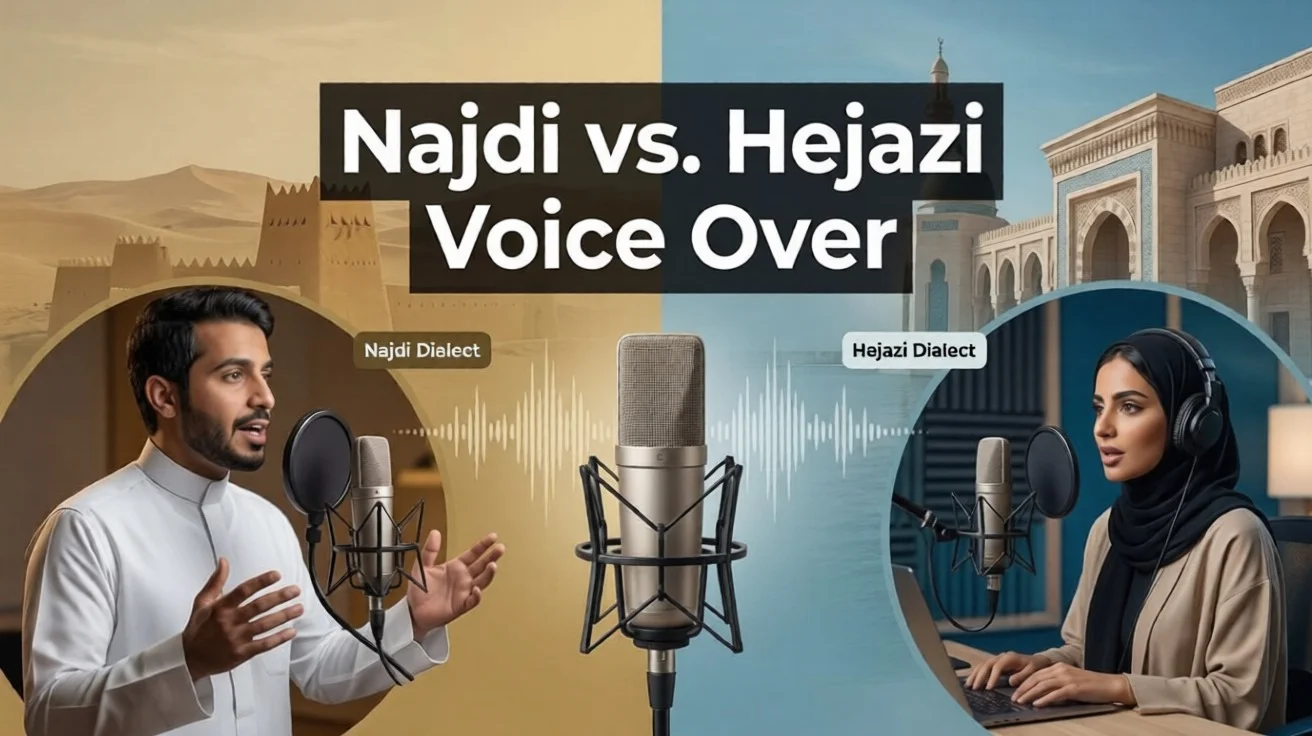



Najdi vs. Hejazi is the first real decision in any Saudi Arabic voice over brief. Najdi and Hejazi are the two most commercially important Saudi Arabic dialects for voice over work. Najdi, spoken in Riyadh and central Saudi Arabia, carries a more conservative, formal register rooted in Bedouin heritage — the default choice for government, banking, and corporate content. Hejazi, spoken in Jeddah, Mecca, and Medina along the western coast, has a softer, more urbane sound shaped by centuries of trade and pilgrimage — better suited to retail, hospitality, and lifestyle content. Choosing the wrong one doesn’t make your content incomprehensible, but it does make it noticeably less authentic to a Saudi ear.

Where Each Dialect Comes From
Najdi Arabic is the historical dialect of central Saudi Arabia, including Riyadh, Qassim, and Hail. It’s often described as more phonologically conservative than coastal dialects, and is closely associated with Bedouin heritage. Hejazi Arabic developed in the western cities along the Red Sea — Jeddah, Mecca, and Medina — which for centuries welcomed traders and pilgrims from across the Muslim world. That history left a real linguistic mark: Hejazi includes loanwords from Turkish and Urdu that Najdi doesn’t share, giving it a comparatively softer, more cosmopolitan sound.
Real Phonetic and Vocabulary Differences
These aren’t just stylistic impressions — the two dialects differ in identifiable, specific ways that a trained voice artist embodies naturally and a generic reading misses entirely.
| Feature | Najdi | Hejazi |
| “What do you want?” | وش تبي؟ (Wesh tabi?) | إيش تبغى؟ (Ēsh tabgha?) |
| “Now” | الحين (al-ḥīn) | دحين (daḥḥīn) |
| Consonant sound (ج) | Often pronounced as a hard “g” | Closer to standard Arabic “j” sound |
| “th” sounds (as in “the”/”three”) | Retained closer to Modern Standard Arabic | Often shifted to /d/ or /t/ sounds |
| General pace and tone | Slower, more measured, formal | Softer, faster, more conversational |
| Loanword influence | Minimal external influence | Turkish and Urdu loanwords from trade/pilgrimage history |
These examples are illustrative of well-documented dialectal patterns and should be reviewed with a native Najdi and Hejazi speaker before being used verbatim in scripts, since sub-regional variation exists within both dialects.
Which Dialect Fits Which Type of Content
| Content Type | Recommended Dialect | Why |
| Government & public sector | Najdi or formal MSA | Conservative, authoritative register suits formal citizen-facing communication |
| Banking & financial services | Najdi | Formality signals trust and precision for financial messaging |
| Retail, lifestyle & hospitality | Hejazi | Warmer, more conversational tone suits consumer-facing brands |
| Real estate — residential/lifestyle | Hejazi or Najdi depending on target city | Match the dialect to the property’s actual regional market where possible |
| Tourism marketing (Red Sea, Jeddah-based campaigns) | Hejazi | Aligns naturally with the coastal, cosmopolitan positioning of western-region tourism |
| Riyadh-based corporate/government campaigns | Najdi | Matches the region and formal register expected in the capital |
A Third Option: When Neither Dialect Is Right
For pan-Saudi or pan-Gulf campaigns — content that needs to work equally well in Riyadh, Jeddah, and beyond Saudi Arabia into the wider GCC — Modern Standard Arabic or a neutral Khaleeji (Gulf) reading is often the safer default rather than picking one regional dialect and risking under-resonating elsewhere. It’s also worth noting that Saudi Arabia has a third major dialect group, Jonoubi, spoken in the southern regions of Asir, Jazan, Najran, and Al-Baha, which shares similarities with Yemeni Arabic — relevant if your specific audience is concentrated in the south, though it’s far less commonly requested for commercial voice over than Najdi or Hejazi.
How to Confirm You’re Getting the Right Dialect
1. Always request a sample specifically labeled Najdi or Hejazi, not just “Saudi Arabic” or “Gulf Arabic” — the terms are sometimes used loosely by providers
2. Ask whether the artist is a native speaker from the actual region, not simply someone who can imitate the accent convincingly
3. For high-stakes content (government, banking, major campaign launches), have a native speaker from your target region review the final recording before publishing
4. If your audience spans both Riyadh and Jeddah, consider whether two separate regional versions would outperform a single compromise reading
Frequently Asked Questions
What’s the main difference between Najdi and Hejazi Arabic?
Najdi, spoken in Riyadh and central Saudi Arabia, is more phonologically conservative and formal, rooted in Bedouin heritage, while Hejazi, spoken in Jeddah, Mecca, and Medina, has a softer sound shaped by centuries of trade and pilgrimage, including Turkish and Urdu loanwords.
Which dialect should I use for a Riyadh-based business?
Najdi is generally the better fit for Riyadh-based or central Saudi audiences, particularly for formal content like banking, government, or corporate communications.
Is Hejazi easier for non-Saudi Arabic speakers to understand?
Hejazi’s softer phonology and greater proximity to Modern Standard Arabic in some sound patterns can make it feel slightly more accessible to broader Arabic speakers, though both dialects are mutually intelligible with MSA and with each other.
Can one voice artist deliver both Najdi and Hejazi convincingly?
Some experienced bilingual-dialect artists can, but it’s worth requesting distinct samples in each dialect specifically rather than assuming general fluency in “Saudi Arabic” covers both authentically.
What if my campaign targets all of Saudi Arabia, not one region?
For genuinely pan-Saudi campaigns, Modern Standard Arabic or a neutral Khaleeji reading is often a safer default than choosing one regional dialect, unless you have the budget to produce separate Najdi and Hejazi versions.
Not sure which dialect fits your project or target city? Contact us with your campaign details and audience, and we’ll recommend Najdi, Hejazi, or a neutral alternative before you record anything.